
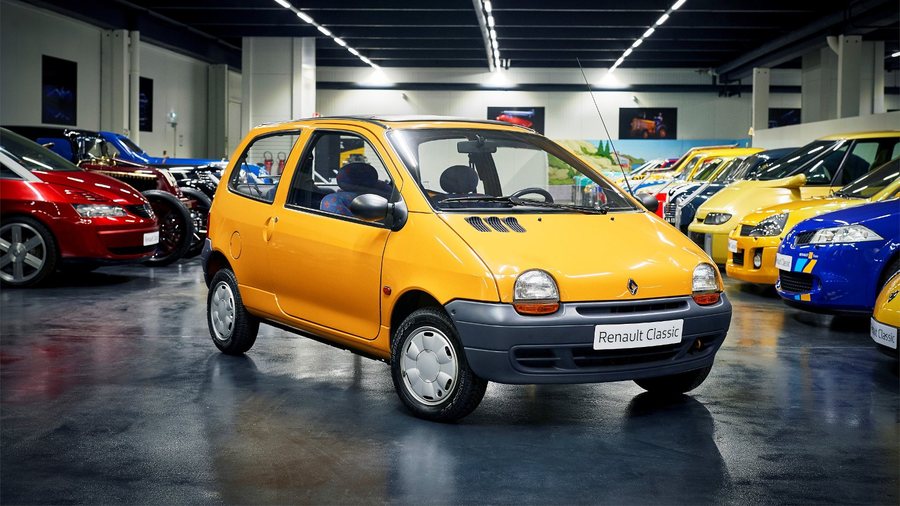
At the 2024 Paris Motor Show, Renault is displaying the prototype of the future electric Twingo, due in 2026. Its round headlights and egg-shaped silhouette pay direct tribute to the 1992 Twingo, which was unveiled… at the very same show, thirty-two years earlier.
1992: the car that looked like nothing else
On 5 October 1992, Renault unveiled a city car at the Paris show that looked like no other. A one-box design, "frog-eye" headlights, a single trim level and four bright colours at launch: the Twingo, designed under Patrick Le Quément, caught everyone off guard. On sale from spring 1993, it relied on a versatile interior with a sliding rear bench, and a keen entry price.
The critics were divided; the public loved it. The Twingo became a social phenomenon, with around 2.5 million built in France up to 2007, without ever changing its shape.
Special editions, a playground for collectors
To keep the success going, Renault produced special edition after special edition, often in partnership with well-known brands: Benetton, Kenzo, Perrier, L'Oréal and many more. Each had its own colours, its own upholstery and, above all, its own logos, applied to the tailgate or to the front wings above the indicator repeaters.
These are precisely the editions collectors are after today. A standard Twingo remains an affordable car; a complete limited edition, with its original graphics and upholstery, is becoming a sought-after piece. The original logos, after thirty years of sun and car washes, are often the first things to need replacing, such as the Twingo Kenzo set or the United Colors of Benetton logo.
Is the Twingo 1 already a youngtimer?
Yes, and probably more than you might think. The earliest cars are now over 30 years old and, in France, can be registered as classics. Dedicated meets are springing up, the clubs are active, and well-preserved examples are becoming scarce: many Twingos ended their days as first cars for young drivers, without much care.
It has plenty going for it as a first classic: simple mechanicals, parts that are still easy to find, reasonable fuel consumption and maintenance within reach of a home mechanic. The weak spots are well known: corrosion on the sills and wheel arches, the condition of the fabric sunroof where fitted, and wear on the clutch and seats.
One detail that changes everything: the tailgate badge
The "Twingo" logo on the tailgate changed over the different phases. On a faithful restoration, using the right badge matters as much as the right body colour: the one from the early years (1992 to 2004) is not the same as the one from the later years. A small detail, but it's the first thing you see when you walk up behind the car.