
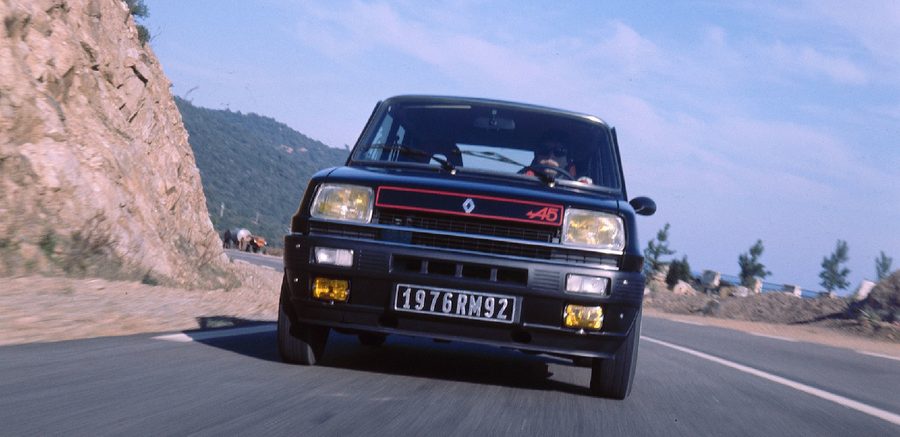
The Geneva Motor Show has just lifted the covers off the electric Renault 5 E-Tech, the production version of the 2021 concept. Square headlights, a dummy bonnet scoop, "black plastic" style bumpers: everything about it recalls the 1972 supermini. Yet for many enthusiasts, the real legendary R5 is the one that was tuned, blown and sometimes turned completely inside out in the name of speed.
1972: a small car that rewrote the rules
When the Renault 5 arrived in January 1972, it practically invented the modern small car single-handed: a hatchback, polyester bumpers instead of chrome ones, and a cabin designed for town driving. It was an instant and lasting success. Before long, people at Renault were asking the obvious question: what would that light bodyshell do with a proper engine?
R5 Alpine: the everyday sports car
The answer came in 1976 with the Renault 5 Alpine. Its 1.4-litre engine gained a reworked cylinder head and a twin-choke carburettor, climbing to 93 bhp, with a five-speed gearbox. For the time, that was a lot in a car of that size. In Britain, where the Alpine name belonged to another manufacturer, it was sold as the Gordini.
The Alpine Turbo followed in 1981, swapping the twin-choke carb for a turbocharger and rising to 110 bhp. Both versions can be told apart by their graphics: side stripes, tailgate badges and the "TURBO" lettering on the rear window, depending on the model year. These details changed a great deal in just a few years and give restorers plenty of headaches: a 1977 kit has nothing in common with a 1983 one.
R5 Turbo: mid-engined madness
Meanwhile, Renault was preparing something far more radical. Unveiled at the 1978 Paris Motor Show, the Renault 5 Turbo had little left of the supermini: a turbocharged engine where the rear seat used to be, rear-wheel drive and huge rear wings. It was built for competition and soon proved it: Jean Ragnotti won the 1981 Monte Carlo Rally at the wheel, followed by the 1982 Tour de Corse.
The Turbo 2, launched in 1983, used more production parts to bring the price down, while the Maxi Turbo versions became rally monsters. Period competition liveries, such as Ragnotti's Tour de Corse car, remain among the most reproduced on today's replicas.
Supercinq GT Turbo: the 1980s heir
In 1985 the Supercinq replaced the R5. Its GT Turbo version carried the torch with a 115 bhp 1.4 turbo in a car weighing under 850 kg. It became the favourite hot hatch of a generation, with its specific bumpers, side skirts and grille and boot badges. Today it is a highly sought-after youngtimer, and often heavily modified: finding an unmodified original example is getting difficult.
And where does the new R5 fit in?
The electric R5 openly plays the nostalgia card, and Renault makes no secret of it: back in 2022, the R5 Turbo 3E concept shown at Chantilly already borrowed the widened silhouette of the Turbo, in electric form. A sporty Alpine-badged version has also been announced. It remains to be seen whether these models will share the fate of their ancestors, which are now being restored piece by piece.
One thing is certain: the R5 being back in the news is pushing up the value of the old ones. Many owners are pulling their Alpine or GT Turbo out of the garage for a refresh, and rediscovering just how much the details matter: the right stripe colour, the right badge, the right label under the bonnet.
Restoring a sporting R5? The graphics changed from one year to the next: before ordering, check the exact model year of your car (late 1981 – April 1982 or later for the Alpine Turbo, for example), as shown on the Alpine Turbo 1982-1984 kit page.