
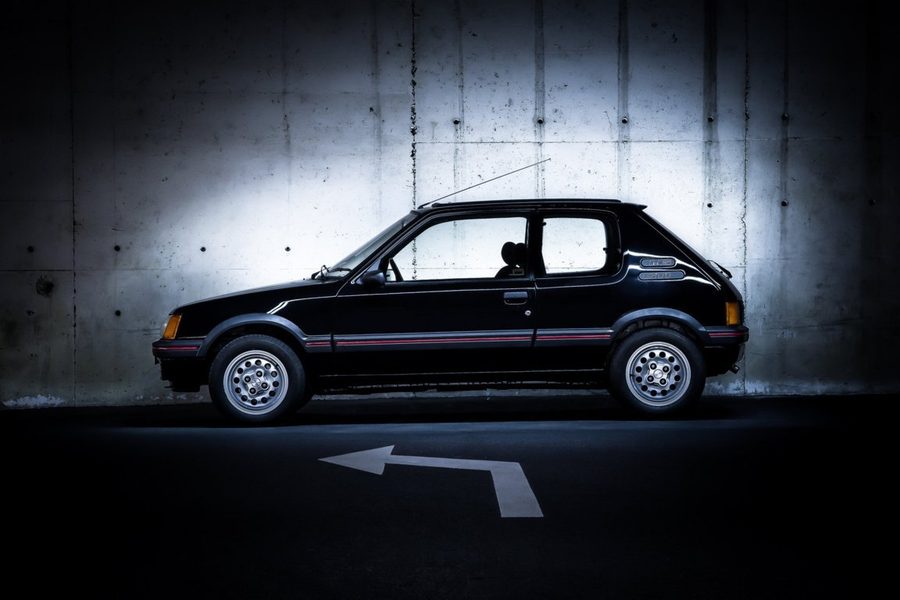
Forty years ago, Peugeot launched the 205 GTI. A small three-door weighing 880 kg, a 105 bhp 1.6-litre engine, red pinstripes and alloy wheels: on paper, nothing revolutionary. In reality, it was the car that would define the affordable hot hatch for an entire generation.
1983-1984: the 205 arrives at just the right time
Peugeot was going through a tough patch in the early 1980s. The 205, unveiled in February 1983, had to save the company. It did so beyond all expectations, and the range quickly grew. Meanwhile, the 205 Turbo 16 was being readied for the World Rally Championship, which it won in 1985 and 1986. The sporting image was there for the taking.
The GTI arrived in 1984 with a 105 bhp 1.6-litre engine, a five-speed gearbox and 14-inch alloy wheels. Its featherweight build did the rest: the car was lively and playful, sometimes a little too much so for inexperienced drivers, which is also part of its legend.
115 bhp, then 1.9: the range gains power
In 1986 the 1.6 rose to 115 bhp, and a new version appeared at the Paris Motor Show: the 205 GTI 1.9, with 130 bhp, 15-inch wheels of a specific design and rear disc brakes. The two versions would live side by side until the end of production. Among purists, the debate between the "sharper" 1.6 and the "torquier" 1.9 is still not settled.
Around the GTI orbit other versions that have become cult cars in their own right: the CTI cabriolet, the XS and GT for tighter budgets, the stripped-out, lightweight 205 Rallye, and the Griffe edition at the end of its run. The GTI left the price list in 1994, after almost 300,000 cars.
How to spot an original 205 GTI
Many 205 GTIs have lived several lives: tuning, accidents, rough-and-ready repairs. Unmodified examples have become rare, and the details make all the difference when buying or selling:
- the badges: "GTI" on the rear quarter panels and the grille, tailgate lettering, whose design and size varied over the years;
- the red pinstripes on the bumpers and side mouldings;
- the interior: red carpets and seat belts, specific seats, three-spoke steering wheel;
- the engine bay: the technical labels (airflow meter, coolant, alternator and battery) are often the first to go during an over-enthusiastic clean.
These details don't tell you everything about the mechanical condition, but they tell the car's story. An engine bay with all its labels still in place is often the sign of a careful owner.
A youngtimer that has gained value
Long seen as a cheap little hot hatch, the 205 GTI is now a fully fledged classic. In France, cars over 30 years old qualify for the collector's registration (carte grise de collection), and the gatherings held for its 40th birthday draw hundreds of cars. The result is simple: more restorations, and better ones, aiming to bring the car back to how it left the factory.
Before replacing an engine label, check the exact version of your GTI (1.6 105 bhp, 1.6 115 bhp or 1.9 130 bhp): the airflow meter references differ, as shown in our engine bay sets.