
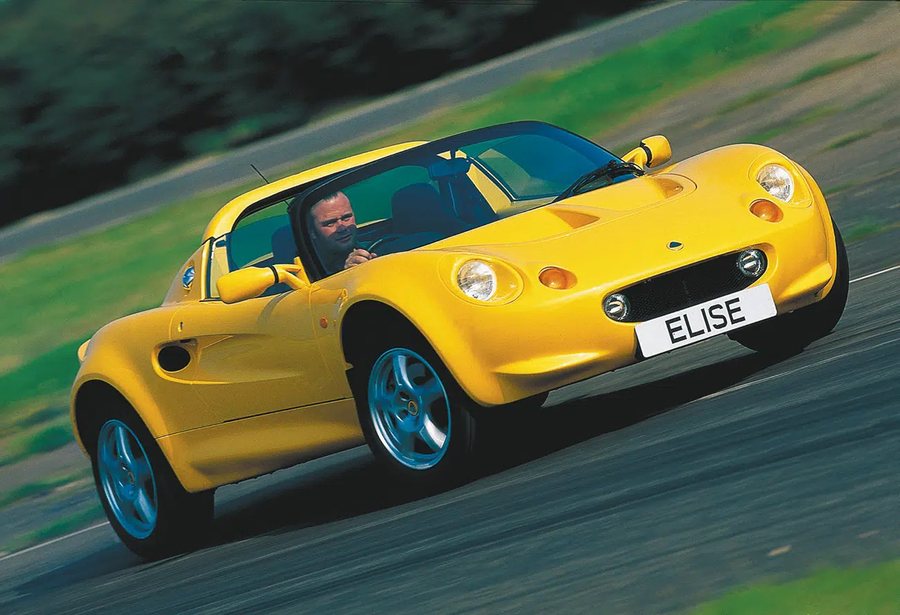
In September 1995, at the Frankfurt Motor Show, Lotus unveiled a small roadster weighing under 700 kg that would save the company. Thirty years on, the Elise remains the absolute benchmark for driving pleasure, and the first series, the S1, has become a much-coveted youngtimer.
A car built around one idea: lightness
In the mid-1990s, Lotus was in trouble. Its owner at the time, Romano Artioli, who also owned Bugatti, launched a project that was simple on paper: a return to Colin Chapman's philosophy, "simplify, then add lightness". The result was an extruded and bonded aluminium chassis, composite bodywork and equipment pared down to the bare essentials.
The car was named after Romano Artioli's granddaughter, Elisa, who was there at the unveiling. With a Rover 1.8-litre four-cylinder of around 120 bhp, it was no powerhouse, but its low weight took it from 0 to 62 mph in under 6 seconds and, above all, gave it handling of rare precision.
The S1 versions
On sale from 1996, the Elise S1 soon branched out: the 111S with its 145 bhp variable valve timing engine, the Sport 135, and limited editions with spectacular liveries, such as the black and gold scheme inspired by the Lotus Type 49 for the company's 50th anniversary. It also spawned the radical 340R and the first Exige, with a fixed roof, in 2000.
In 2001 the Elise S2 took over with redesigned bodywork, followed by the S3. Elise production ended in late 2021, after more than twenty-five years, a rare longevity for a sports car.
Buying an Elise S1 today
The S1 appeals for its purity: no electronics, direct controls and lines that haven't aged a day. It does, however, call for some care when buying:
- the chassis: aluminium doesn't rust, but an impact can bend it, and it is hard to repair. A look underneath on a ramp is essential;
- the Rover engine: the head gasket is its well-known weak point. Keep an eye on the temperature and the coolant;
- the composite bodywork: repairs often show up as differences in colour between panels;
- the graphics: on special editions, the original logos and stripes are essential to the car's value.
A car to be driven
More than a classic to be kept under a cover, the Elise is a car to be driven, on the open road as well as on track, where it proves formidable against far more powerful sports cars. That is what makes it so endearing: thirty years on, it still does exactly what it was designed to do.
The Type 49 editions and the 111S versions, recognisable by their graphics, are among the most in demand: see for example the JPS Type 49 gold set or the 111S graphics.